The replacement kills Ari
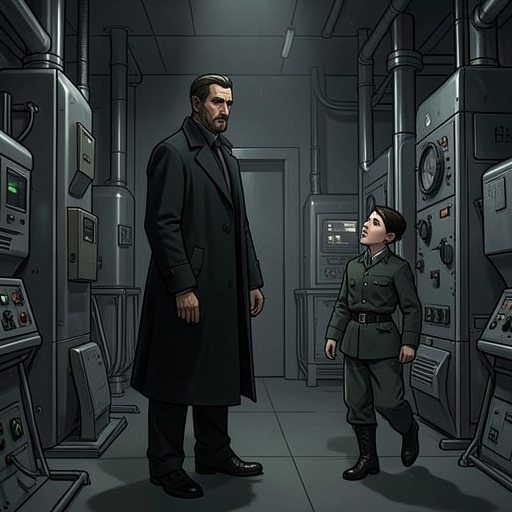
The HumansAri’s murder turns the Alien narrator’s growing suspicion into a confirmed threat. A distressed woman tells him that Ari is dead; later, a man wearing Andrew Martin’s familiar form admits to killing him and explains that the order extended beyond destroying information. The scene reveals that the narrator’s connection to his people has not been severed as completely as he believed: they can still monitor him and have acted against someone who knew his origins.
Discovery and immediate response
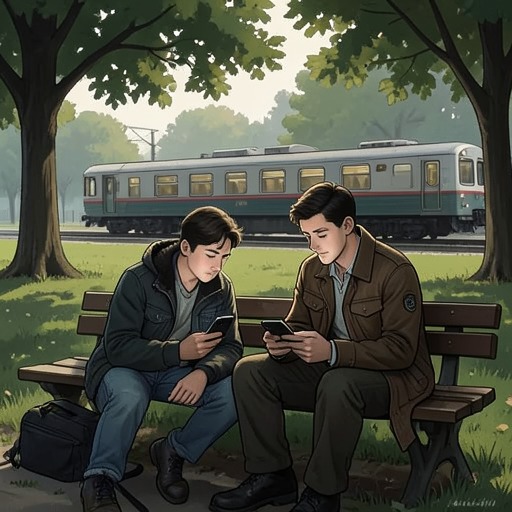
A man has just left the narrator, and a cloud passing over the sun prompts a dark thought. The narrator stands, takes out his phone, and calls Ari. A woman answers, breathing heavily and struggling to speak coherently. When the narrator asks for Ari, she repeats that he is dead. The account does not identify the woman, explain where Ari was killed, or describe how it happened; the murder first reaches the narrator as a bare, repeated fact.
The narrator runs. That abrupt response marks a change from uncertainty to urgent action: Ari’s death is not merely news of a loss but a warning that the danger has reached someone connected to him. The scene withholds the circumstances of the killing, keeping the reader’s attention on what the narrator can establish and on the threat implied by the message.
The replacement’s admission
At the house, the narrator passes the kitchen and tries to wake Newton, who remains deeply asleep. A voice calls from the living room. The narrator follows it and finds a man sitting on the purple sofa, one leg crossed over the other. The figure is at once unmistakably familiar and frightening: he has the form and face of Andrew Martin, though his jeans, T-shirt, and trainers differ from the clothes the narrator associates with that appearance, and he has no bruises.
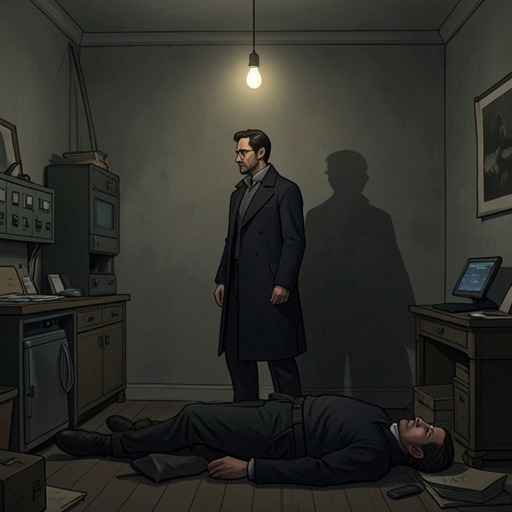
The narrator asks directly whether this man killed Ari. He answers yes. This confirmation makes the earlier phone call more than an unexplained bereavement: Ari was killed by the replacement. Yet the evidence offers no account of the act itself, so the event’s force lies in the admission and in the identity of the person who gives it. The familiar face that might have implied recognition or safety instead belongs to an agent carrying out a separate, more extensive mission.
The order behind the murder
The replacement describes his instructions as broader than the narrator’s. His task was not only to destroy information; he had also been told to kill anyone the narrator had told about his origins. Ari’s murder therefore exposes a direct link between what the narrator disclosed and the replacement’s violence. The account does not establish precisely what Ari knew, or when the replacement acted, but it makes clear why the narrator’s conversations could put another person in danger.
The narrator objects that Ari did not know the Riemann hypothesis had been proved. The replacement’s answer distinguishes that mathematical secret from the information at stake: the order concerns the narrator’s origins. In that distinction, the episode widens the threat from suppression of a discovery to the silencing of people who can connect the narrator to his alien identity.
Surveillance and consequence
The narrator asks whether his people have been listening, since he had been told that he was disconnected. The replacement points to the technology still present in the narrator’s left hand and explains that the narrator’s powers were taken away, but his people retained their own means of listening and checking on him. The apparent disconnection was thus incomplete: the narrator had lost abilities without ending their access to him.
Ari’s death consequently changes the meaning of separation. The narrator is not simply cut off from a distant society; he remains subject to its attention, while the replacement acts under instructions the narrator did not know existed. The scene closes on this asymmetry: the narrator learns both that a friend has been killed and that the system he thought he had escaped can still observe him. The murder makes that surveillance concrete, and turns the narrator’s origins from private knowledge into a source of danger to others.